Kueski
Personal Debits: Automating Kueski's Loan Repayments
Designing Kueski's direct-debit repayment flow, checkout to deactivation, as the first shipped milestone in a larger effort to unify a customer experience rated 2.8 out of 5.

- 25+ screens
- designed and shipped
- 2.8 out of 5
- customer rating before the fix
My role
I designed it end to end: checkout, status tracking, method setup and deactivation.
The problem
Customers were forgetting to make their loan repayments, which raised collections' operational load and hurt cash flow.
The result
A complete repayment flow of more than 25 screens, shipped as the first milestone of the CX Tribe's four-part roadmap.
The problem
Kueski's Customer Experience Tribe was working against a documented fragmentation problem: "Kueski faces a critical fragmentation challenge across its products and operations. Isolated systems and outdated infrastructure lead to inconsistent user experiences and inefficient internal processes." A UX audit backing that statement found no customer journey had ever been mapped, no documentation existed, and no flows had been finalized. A widget survey of 2,197 respondents rated the experience 2.8 out of 5, with 63% of respondents describing themselves as dissatisfied, recurring users rating it 3 points and new users rating it 2.5.
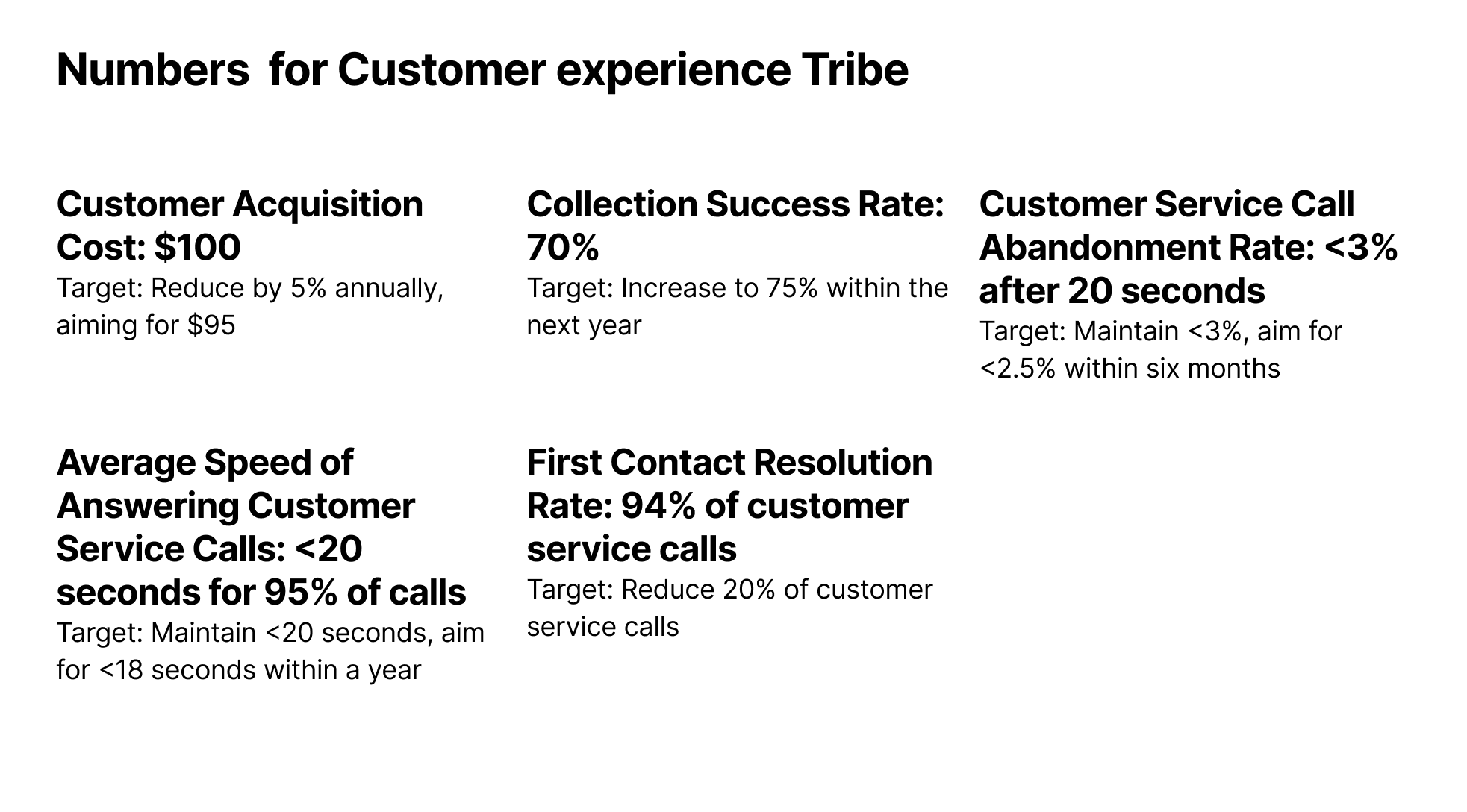 Slide titled Numbers for Customer experience Tribe, on a white background, with five baseline metrics and their targets. Customer Acquisition Cost is $100, target: reduce by 5% annually, aiming for $95. Collection Success Rate is 70%, target: increase to 75% within the next year. Customer Service Call Abandonment Rate is under 3% after 20 seconds, target: maintain under 3% and aim for under 2.5% within six months. Average Speed of Answering Customer Service Calls is under 20 seconds for 95% of calls, target: maintain under 20 seconds and aim for under 18 seconds within a year. First Contact Resolution Rate is 94% of customer service calls, target: reduce 20% of customer service calls.
Kueski CX Tribe: Numbers
Inside that larger problem, one product-level issue stood out as both concrete and expensive: repayments. Kueski customers were forgetting to make their loan repayments, which raised collections' operational load and hurt cash flow, and Kueski was paying more to process debit-card payments inside its own ecosystem than it would to collect them by direct debit. Two secondary risks made the fix urgent rather than optional: a real number of cards were marked as validated in the system when they weren't (a compliance risk), and if a user paid manually while a direct-debit charge was already processing, the payment could get duplicated (a servicing risk). This was tracked as a real ticket, PRODU-21514, and became Personal Debits: domiciliación, an automatic recurring debit-card payment for loan repayments, and the first milestone (M1) of the CX Tribe's four-part roadmap.
Approach
The Tribe worked the problem through a "3 diamond" method: Problem Space, Solution Space, Concrete Space, pairing Research Discovery with Design Thinking rather than jumping straight to screens.
- Framed every named problem on one map before picking what to build. Plotted issues like unclear registration, unknown credit capacity, UX hierarchy, and inconsistent installment offers on a 2x2 of client impact against Kueski impact, split into product problems and operational ones, so prioritization wasn't a debate about opinions.
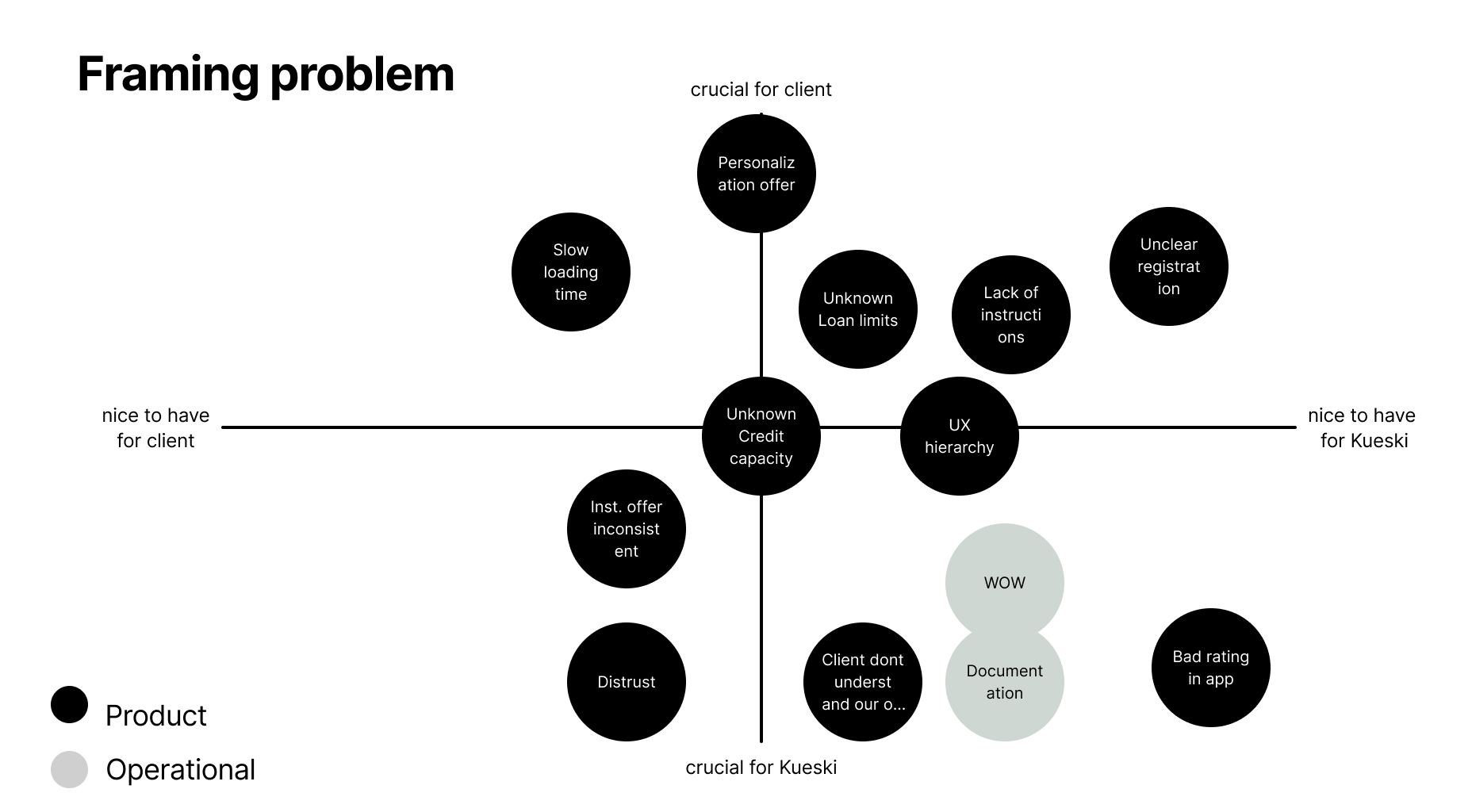 Slide titled Framing problem, a 2x2 map. The vertical axis runs from crucial for client at the top to crucial for Kueski at the bottom. The horizontal axis runs from nice to have for client on the left to nice to have for Kueski on the right. Product problems are black circles and operational problems are gray. On the axes: Personalization offer at the top, Unknown credit capacity at the center and UX hierarchy just right of center. Upper left: Slow loading time. Upper right: Unknown loan limits, Lack of instructions and Unclear registration. Lower left: Installment offer inconsistent and Distrust. Lower right: Client doesn't understand and our offer, Bad rating in app, and the two gray operational problems WOW and Documentation. A legend at the bottom left explains black as Product and gray as Operational.
Kueski CX Tribe: Framing Problem
- Sequenced the fix into four milestones instead of one big rebuild. M1 Sign up & registration, M2 Credit capacity, M3 Account linking + default payment method, M4 Migration: Home to ecosystem, each with its own JTBD, objectives, and initiatives, so the Tribe could ship value before the whole ecosystem was unified.
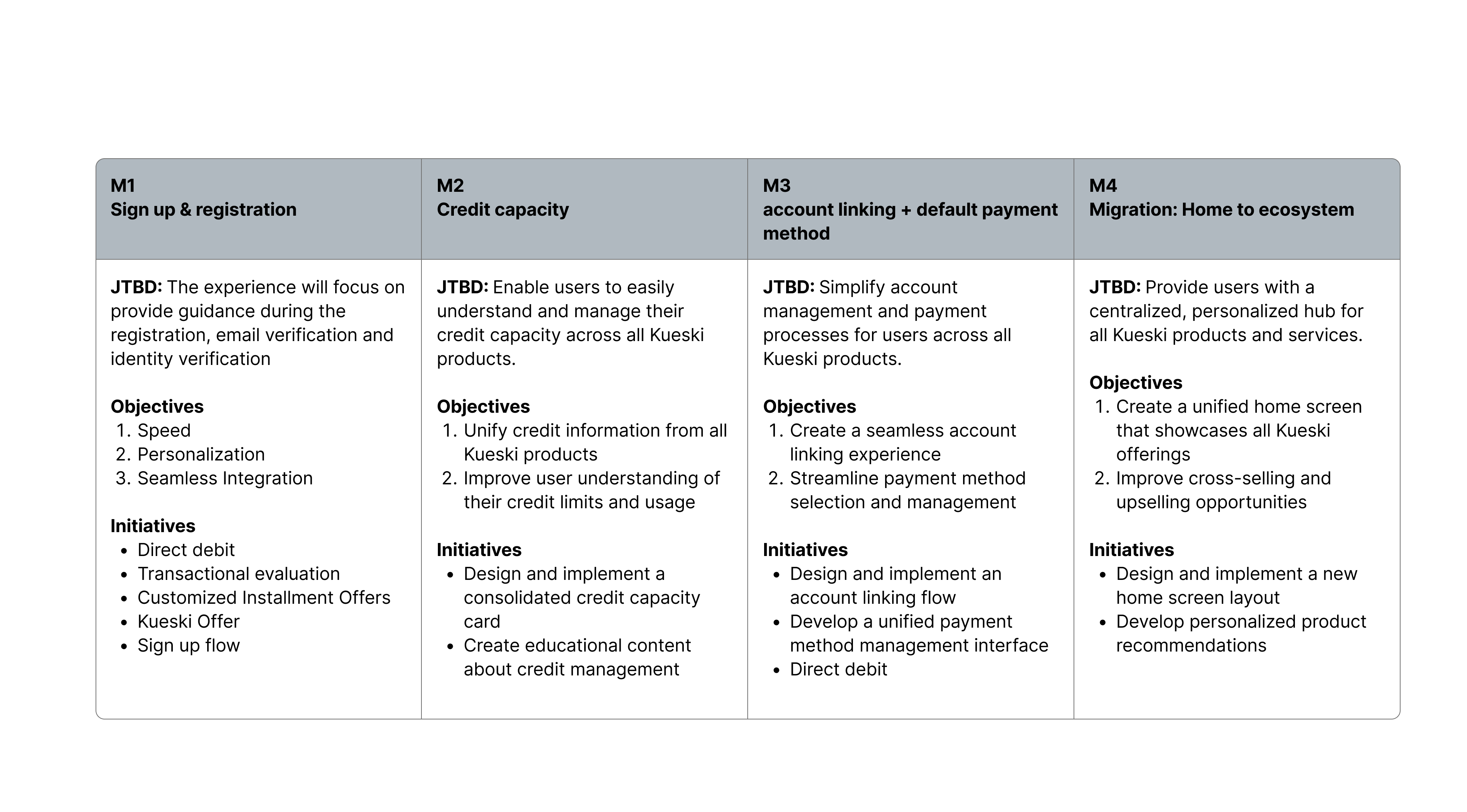 Slide titled Direction: the solution considers the following value delivery progress. A four-column table, one column per milestone. M1, Sign up and registration. Job to be done: the experience will focus on providing guidance during registration, email verification and identity verification. Objectives: speed, personalization, seamless integration. Initiatives: direct debit, transactional evaluation, customized installment offers, Kueski offer, sign up flow. M2, Credit capacity. Job to be done: enable users to easily understand and manage their credit capacity across all Kueski products. Objectives: unify credit information from all Kueski products, and improve user understanding of their credit limits and usage. Initiatives: design and implement a consolidated credit capacity card, and create educational content about credit management. M3, account linking plus default payment method. Job to be done: simplify account management and payment processes across all Kueski products. Objectives: create a seamless account linking experience, and streamline payment method selection and management. Initiatives: design and implement an account linking flow, develop a unified payment method management interface, and direct debit. M4, Migration: Home to ecosystem. Job to be done: provide users with a centralized, personalized hub for all Kueski products and services. Objectives: create a unified home screen that showcases all Kueski offerings, and improve cross-selling and upselling opportunities. Initiatives: design and implement a new home screen layout, and develop personalized product recommendations.
Kueski CX Tribe: Direction (M1–M4)
Direct debit sat inside M1 as an initiative, alongside transactional evaluation and customized installment offers, and it showed up again under M3's payment-method initiatives, since domiciliación is both something a new customer sets up and something an existing customer manages later. I designed it end to end: checkout, status tracking, method setup, and deactivation, working with product manager Juanpa, engineer Fili, QA lead Rob, writer Gio, and researcher alexis.
- Made domiciliación the default at the point of highest intent. In the Kueski Pay checkout itself, where a customer is already choosing how many quincenas to pay a purchase over, "Activar Domiciliación de Pago" is toggled on by default, with plain language about what it does before the customer ever has to think about a missed payment.
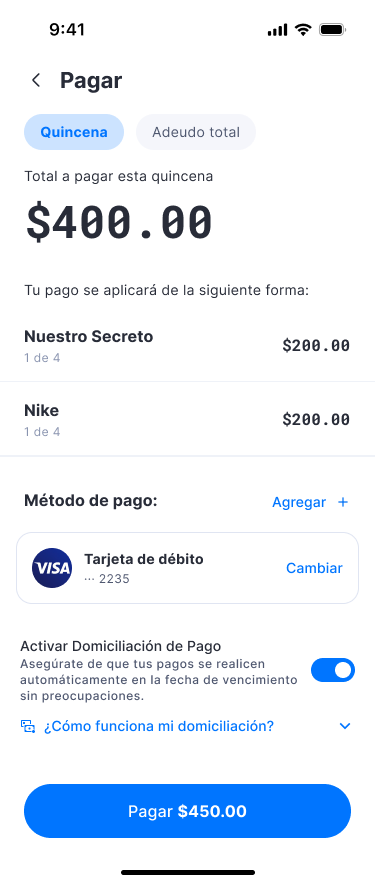
Personal Debits: Checkout
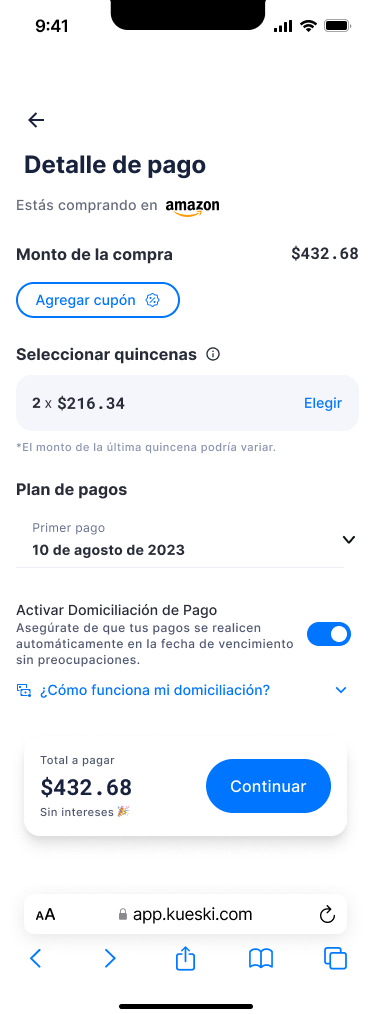
Personal Debits: Amazon Checkout
- Built the payment method form to fail safely, not just fail. Adding a card or CLABE account for domiciliación validates the number inline and tells the customer up front that if their bank isn't on the supported list, domiciliación simply can't be activated, instead of letting them find that out after submitting.
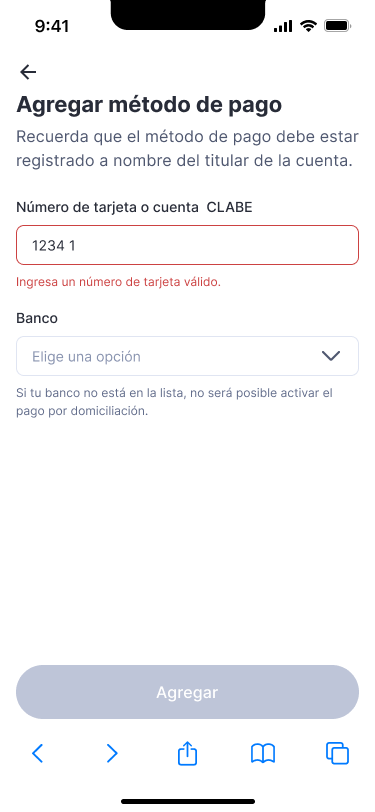
Personal Debits: Payment Method Validation
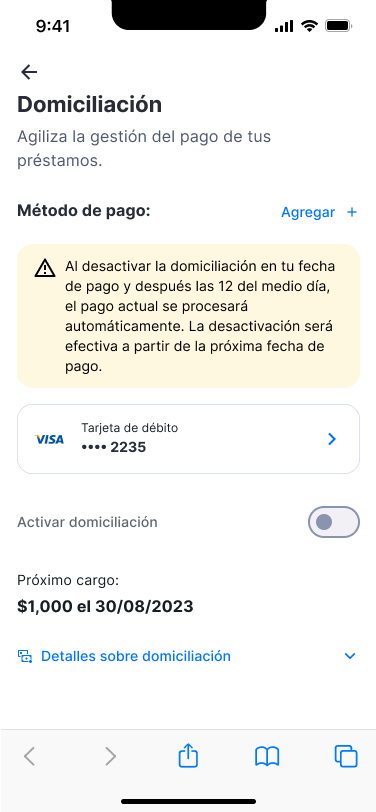
Personal Debits: Deactivation Flow
- Named the duplicate-charge risk directly in the deactivation flow. Turning domiciliación off carries a real edge case: switch it off after noon on your payment due date and the charge already queued that day still goes through, so the interface says exactly that instead of implying deactivation is instant.
- Gave every payment a status the customer could actually read. Each domiciliación charge resolves to one of three states, aplicado, en proceso, or no aplicado, and the applied-payment receipt breaks the charge down into abono a capital, comisiones, intereses, and IVA instead of showing one opaque total.
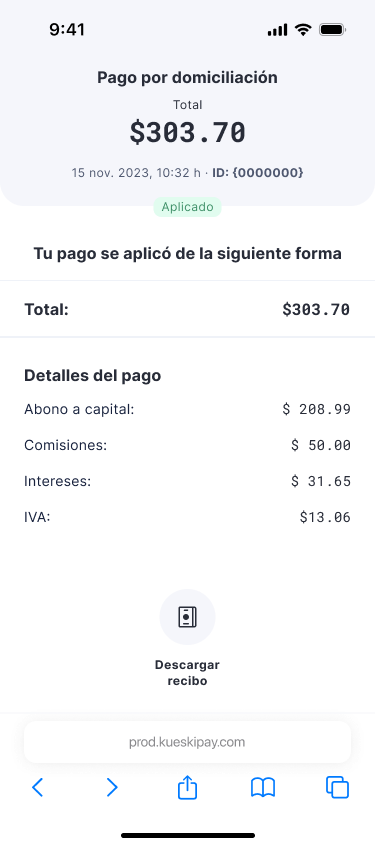
Personal Debits: Payment Status: Aplicado
Key findings
The research behind the roadmap explained why a repayment fix specifically was worth building first. Three personas built from real interviews each hit the same wall from a different angle: Paola Pay in Mexico City found KueskiPay's authorizations unpredictable and its interest-free options too limited; Iván Instore in Ecatepec, State of Mexico got confused by payment dates and admitted to using one debt to pay off another; Carlos Cash, running a small business across Ecatepec, Puebla, and Tijuana, felt his consistent repayment history wasn't rewarded with better loan terms. None of them were describing domiciliación by name, but all three were describing the cost of not having it: unpredictable payments, confusing dates, and no credit for reliability.
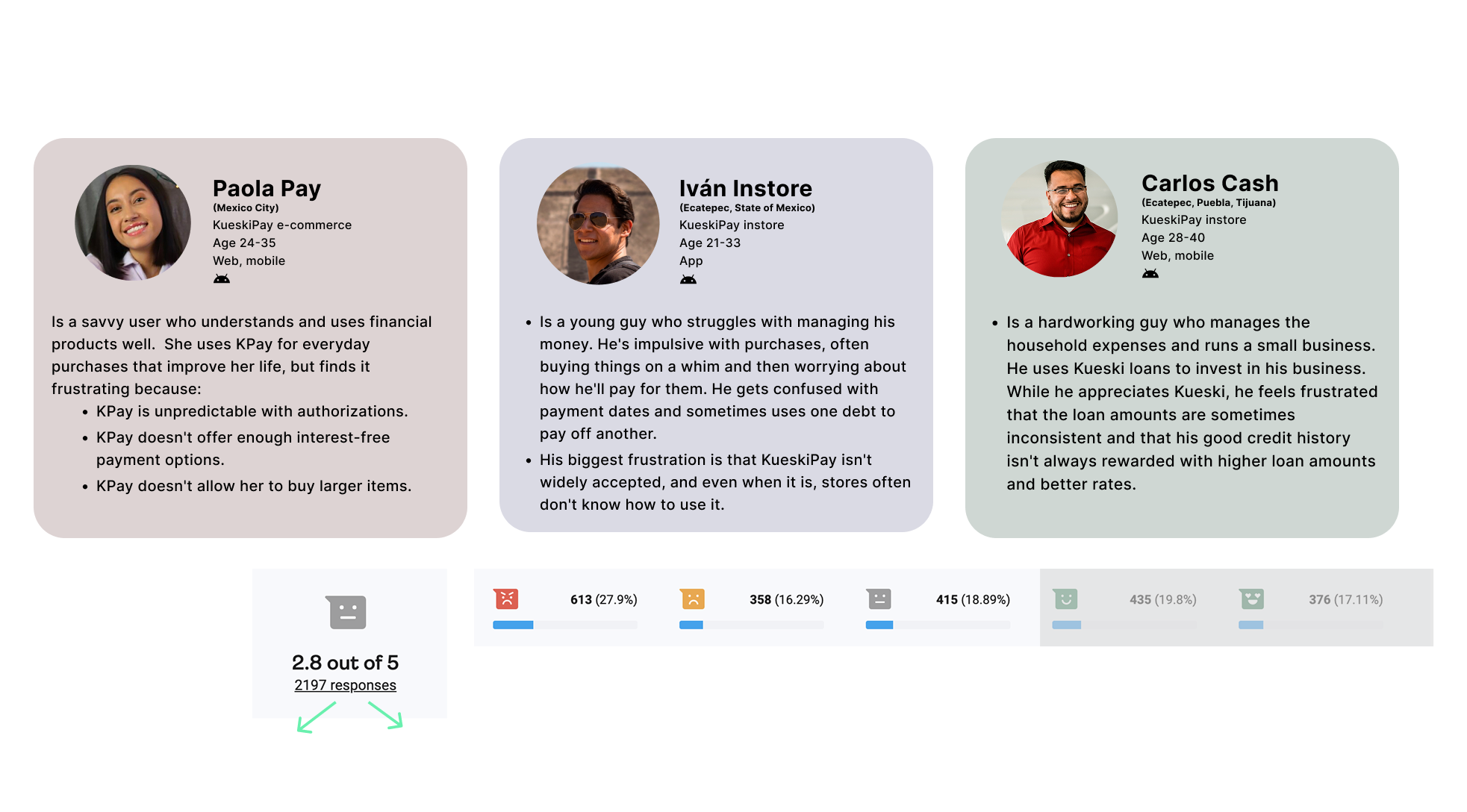 Slide titled Research Findings, About our User, with three persona cards and a widget survey. Paola Pay, Mexico City, KueskiPay e-commerce, age 24 to 35, web and mobile: a savvy user who understands financial products and uses KPay for everyday purchases, but is frustrated because KPay is unpredictable with authorizations, does not offer enough interest-free payment options and does not let her buy larger items. Iván Instore, Ecatepec, State of Mexico, KueskiPay instore, age 21 to 33, app: a young man who struggles to manage his money, is impulsive with purchases and gets confused with payment dates, sometimes paying one debt with another. His biggest frustration is that KueskiPay is not widely accepted and stores often don't know how to use it. Carlos Cash, Ecatepec, Puebla, Tijuana, KueskiPay instore, age 28 to 40, web and mobile: a hardworking man who runs the household expenses and a small business, uses Kueski loans to invest in it, and is frustrated that loan amounts are inconsistent and his good credit history is not always rewarded with higher amounts and better rates. Widget survey: 2.8 out of 5 from 2197 responses, 3 points from returning users and 2.5 points from new users. Responses from the unhappiest face to the happiest: 613 (27.9%), 358 (16.29%), 415 (18.89%), 435 (19.8%) and 376 (17.11%). 63% are dissatisfied with the experience.
Kueski CX Tribe: Research Findings
That gap between recurring and new users in the survey, 3 points versus 2.5, mattered more than the average on its own. Recurring users already trusted Kueski enough to rate it higher even with the same friction, which meant the dissatisfaction wasn't really about the product concept, it was about specific moments like an unpredictable payment date that a returning customer had simply learned to work around. Direct debit removes exactly that moment.
The two named secondary risks, cards marked validated that weren't, and manual payments colliding with an in-progress domiciliación charge, weren't edge cases discovered late. They were written into the original problem statement alongside the operational cost problem, which is why the shipped flow treats them as first-class states (an inline validation step at setup, an explicit warning at deactivation) instead of retrofitting them after a compliance or servicing incident.
Outcome
Personal Debits shipped as a complete loop, not a single screen: checkout enrollment, three-state payment tracking, payment-method setup with inline validation, a deactivation flow with duplicate-charge warnings, automatic deactivation and reminder states, a payment-rejection screen, and chargeback-communication copy for confirmation emails, more than 25 screens built and documented under PRODU-21514.
As M1 of the CX Tribe's four-milestone roadmap, Personal Debits was scoped and measured against the Tribe's shared baseline, including a Collection Success Rate target of 75% (up from a documented 70%) and a Customer Acquisition Cost target of $95 (down from $100), rather than a standalone metric invented for this feature alone. M2 through M4, consolidated credit capacity, account linking, and a unified home, were the next milestones on that same roadmap when this work was documented, and the source material here is the shipped design and the ticket it shipped under, not a post-launch measurement of collection rates or adoption specific to domiciliación. I'm writing this up as what it is: a fully designed, shipped repayment flow inside a larger, still-in-progress fix for a customer experience that was rated 2.8 out of 5 before any of it existed.